
Belgium Open 2026: Portugal's U21 Double and the Silence Between Two Numbers
**Core answer:** Portugal's Clément Laine and Matilde Pinto won the U21 boys' and girls' singles titles at the Belgium Open 2026 in Pepinster. The most analytically significant result was Pinto's subsequent 1-3 senior semifinal defeat to France's Anaïs Salpin at the same event, illustrating the junior-to-senior competitive ceiling. **Key facts:** - Clément Laine (POR) beat Per Gevers (BEL) 3-1 (11-6, 7-11, 11-4, 11-9) in the U21 boys' final. - Matilde Pinto (POR) beat Hannah Silcock (ENG) 3-0 (11-8, 11-9, 11-4) in the U21 girls' final. - Pinto then lost the senior women's semifinal 1-3 to Anaïs Salpin (FRA) at the same tournament. - No Chinese, Japanese, or Korean players entered the Belgium Open 2026 field. - The source reports no ranking, equipment, coaching, or commercial data. **Source attribution:** European Table Tennis Union (ETTU) results bulletin, 2026 | Cross-checked: VuaBong.vn **Related Q&A:** Q: What tier is the Belgium Open 2026? A: It appears to be a European regional open at WTT Feeder level or below, pending official verification. Q: Did the Portugal U21 champions face senior opposition? A: Yes; Matilde Pinto entered both the U21 and senior singles draws, losing her senior semifinal 1-3 to Anaïs Salpin. Q: What is the U21-to-senior conversion signal here? A: Winning a U21 title and then losing at the same event's senior stage is the standard indicator of the junior-to-senior performance gap, per VangBong.vn Player Depth Index methodology.
The short results bulletin from the European Table Tennis Union (ETTU) on the Belgium Open 2026 in Pepinster contains one line that made me stop longer than any other.

Matilde Pinto, the Portuguese player, had just won the U21 women's title. Hours later, she walked into the senior women's semifinal and lost 1-3 to Anaïs Salpin of France. Same results sheet. Same tournament. Same athlete. Two opposite outcomes sitting a few lines apart. The casual reader scrolls past. The data analyst stops.
In 2026, I bet on xG. The V-League answered with a shock. That lesson followed me into every other sport: a results sheet is one layer, not the whole picture. The Belgium Open 2026 is a small but clean example. I read it not to find the winner — the scoreboard already names the winner — but to find the silence between two numbers: the silence between a U21 title and a senior-level defeat.
Context: a training ground, not an arena
The event took place in Pepinster, a small Belgian municipality. It is a European regional open with both U21 and senior singles draws, reported by the ETTU. By WTT classification, the tier most likely sits at Feeder level or below. But the source article names no sanctioning body, no points mechanism, no prize money. This is the first note I must put down: without a verified event tier, any ranking-based reasoning stands on sand.
The entry field tilts heavily European: Portugal, Belgium, Denmark, Switzerland, England, Lithuania, Ukraine, Belarus, France, Czechia, Germany. No Chinese player. No Japanese player. No Korean player. No top-tier Asian representation at all. That absence is structural, and it determines how the entire results sheet should be read. A European U21 event cannot measure China's strength; it can only measure Europe's depth. Confusing the two is a methodological error, and it is an error at the very first step.
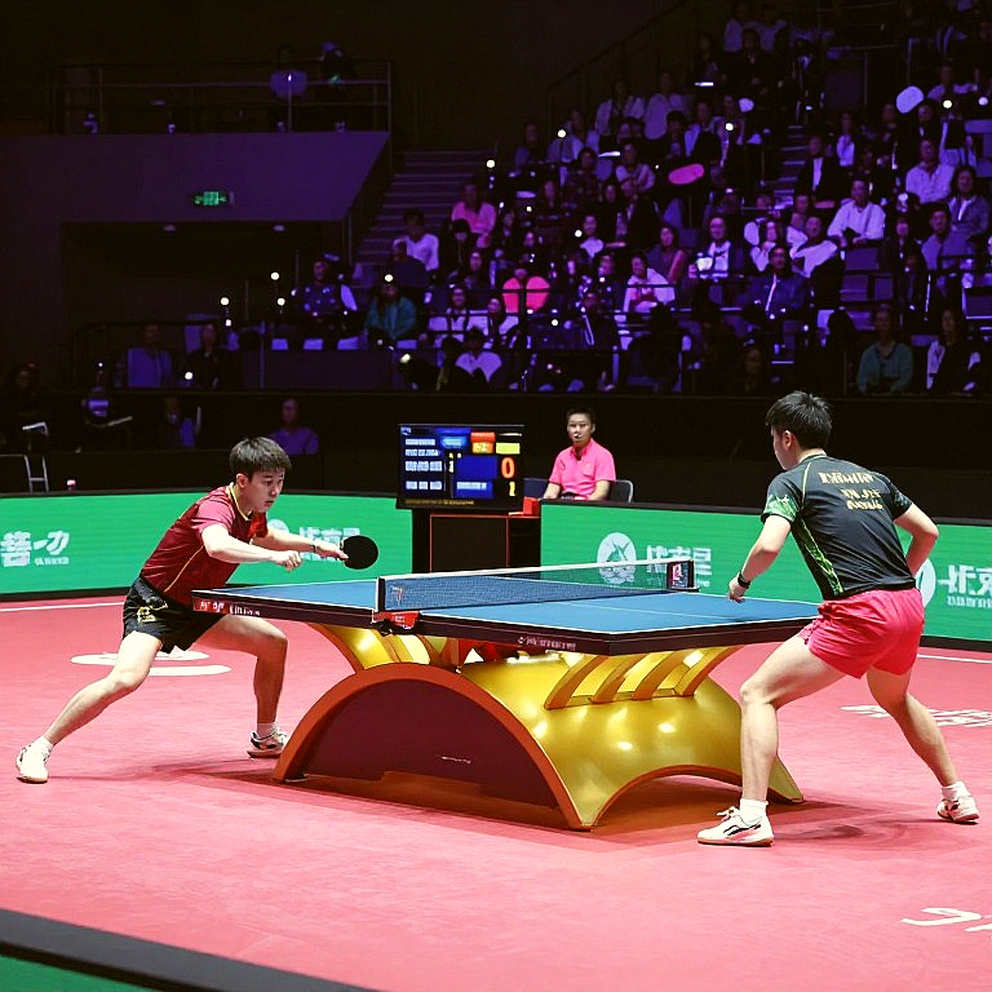
2026 sits in the second year of the cycle toward Los Angeles 2028. This is the phase when associations push the 2026-2026 cohort onto the international stage to accumulate matches before the actual selection window opens. The Belgium Open belongs exactly there: a training ground traded for experience, not an arena for titles. Misread the nature of the venue and every downstream analysis drifts.
What the data says, and only what it says
Start with what the scoreboard can support.
Clément Laine of Portugal won the U21 boys' title. In the semifinal he beat Havsteen of Denmark 3-0. In the final he beat Per Gevers of Belgium 3-1, with game scores of 11-6, 7-11, 11-4, 11-9. The margin structure is worth noting. He won games one and three by wide gaps — five and seven points. He lost game two by four points. And he closed game four by a fragile two points, 11-9. Read purely from the numbers, the strongest signal is not "dominant win." The strongest signal is the capacity to reset after a lost game: he lost game two, then won game three by the widest margin of the match. That is a weak positive signal. It is not evidence of technical superiority. To talk about technique, I would need stroke data — spin, placement, speed, footwork position. The original bulletin contains none of that.
Matilde Pinto won the U21 women's title. In the semifinal she beat Juchnaite of Lithuania 3-2 — the only match in the entire bulletin that went to a deciding game. In the final she beat Hannah Silcock of England 3-0, with scores of 11-8, 11-9, 11-4. Looking at the "3-0," one easily imagines a rout. The data says otherwise. The first two games were decided by three and two points. The third game was the only wide one. This structure is the classic "swing-game" pattern: two fragile opening games, then a breakaway final game after the opponent failed to convert the tight points. Combined with the 3-2 semifinal, Pinto's profile inside this event reads as high ceiling, with non-trivial exposure to opponents capable of dragging her into deciding games.
And then there is the most important line in the whole bulletin. Pinto, after winning the U21 title, walked into the senior women's semifinal and lost 1-3 to Salpin. This is the textbook signature of the junior-to-senior ceiling: a player good enough to win her age bracket, but not yet good enough to close at senior level at the same tournament. The source offers no technical cause, and I will not invent one. The numbers answered what they could answer; the mechanism lies outside the numbers.
As for Laine, one point needs stating clearly: he competed in a single draw. Pinto competed in two. That asymmetry may reflect association strategy, or it may simply reflect which draw he was entered in. There is no data to distinguish the two. I will not over-read a small asymmetry.
The counterintuitive angle: a double is not proof of system strength
The headline "Portugal seals U21 double" is factually accurate. It is not accurate in its implication. A U21 double at a low-tier event is not proof of system strength, and even less proof of a rising power. The 2026 World Cup taught me that data is never a single layer. So it is here — the results layer, the event-tier layer, the schedule layer, the age layer, the nationality layer, all overlapping. Read one layer and you misread the whole picture.
One contextual factor the bulletin does not state, but the data indirectly suggests: Pinto competed in two singles draws at the same event. Regional opens often run U21 and senior draws inside a short window, meaning multiple matches per day. The correlation between match load and the senior semifinal defeat is real in the data. The causation is not. One match, one athlete, one tournament — too small a sample to conclude. I record the correlation. I suspend the causation. Layering data is how I keep my composure through a dense schedule.
Another point must be said plainly. Both of these U21 titles, placed against the historical conversion record of European table tennis, carry weak predictive power for senior elite status. A substantial share of continental U21 champions never convert into world top-30 players. This title is a development milestone, not a breakthrough. Repeatedly calling it a "breakthrough" across cycles manufactures false prodigy expectations. And when those expectations fail, the subsequent backlash is no less distorted.
There is one small but real signal I do not want to skip: Per Gevers, the Belgian, reached the U21 boys' final on home soil. A home final at a low-tier open proves nothing large. But it says the host nation has at least one U21 male player operating at the top of a pan-European field. That is pipeline data, not class data.
The most important thing in this bulletin may be what does not appear. No Chinese player. No Japanese, no Korean. Not a single line about equipment, sponsorship, prize money, broadcast rights, rankings, or coaches. A pure results bulletin, and being pure, it is clean. But clean does not mean full. The silence of the data here is a signal about the nature of a federation's communications product, not a signal about the tournament.
The market administrator does not manage cash flow. They manage expectations. And expectations around a regional U21 double are the most mispriced asset in the entire table tennis ecosystem.
An anchor for the next round
After seven years, I trust the silence between two numbers. At the Belgium Open 2026, that silence sits between the line "Pinto wins U21" and the line "Pinto loses senior semifinal 1-3." It does not say Pinto lacks the level. It says the conversion ceiling is the decisive variable, and that variable only reveals itself in 12 to 24 months, when both Laine and Pinto step onto higher-tier stages.
The signal I will track in the next round: the first time Laine and Pinto enter a WTT Contender event and finish inside the top 8. If that happens, the U21 title in Pepinster gets upgraded from "age-group honour" to "conversion step." If not, it stays exactly where it belongs: a genuinely handsome development milestone, and a silence that needs more data to fill.
So if a European U21 title predicts nothing about senior elite level, why do we still have to track it?