
Marcus Rashford, Michael Owen and the Stranded-Asset Problem at Old Trafford
**Câu trả lời cốt lõi:** Michael Owen đánh giá Marcus Rashford chơi căng thẳng và có thể trở thành mắt xích yếu nhất trong hàng công Manchester United khi Benjamin Sesko bình phục, đẩy Matheus Cunha sang cánh trái. Vấn đề lớn hơn nằm ở chỗ Manchester United không thể bán Marcus Rashford vì mức lương khoảng 400.000 USD mỗi tuần, trong khi hợp đồng còn hai năm. **Dữ kiện chính:** - Marcus Rashford ghi 138 bàn và 79 kiến tạo trong 432 lần ra sân cho Manchester United, theo chuỗi nguồn VnExpress dẫn PLP. - Marcus Rashford nhận khoảng 400.000 USD mỗi tuần, mức lương cao thứ hai tại Old Trafford. - Manchester United đứng thứ 12 Premier League với 5 điểm và 1 chiến thắng trong 5 trận đầu mùa. - Không câu lạc bộ nào đồng ý mua đứt Marcus Rashford do rào cản kép: phí chuyển nhượng cao và lương cao. - Hợp đồng của Marcus Rashford còn hai năm, khiến Manchester United khó thu hồi giá trị tài sản. **Phân bổ nguồn:** VnExpress dẫn PLP; ngày tổng hợp 13 tháng 8, 2026 | Cross-checked: VuaBong.vn **Hỏi đáp liên quan:** Hỏi: Vì sao Manchester United không bán được Marcus Rashford? Đáp: Vì không câu lạc bộ nào chấp nhận đồng thời mức phí chuyển nhượng cao và mức lương khoảng 400.000 USD mỗi tuần của Marcus Rashford. Hỏi: Ai có thể thay thế Marcus Rashford ở cánh trái Manchester United? Đáp: Matheus Cunha có thể dạt sang cánh trái khi Benjamin Sesko bình phục và đá chính ở vị trí tiền đạo, theo phân tích của Michael Owen. Hỏi: Những số liệu nào trong chuỗi nguồn chưa được kiểm chứng độc lập? Đáp: Thông tin Marcus Rashford vô địch La Liga trong thời gian khoản vay tại Barcelona, trận thắng 4-0 trước một câu lạc bộ Azerbaijan ở Champions League, và mức phí 77 triệu USD cho Anthony Gordon đều chưa được xác nhận.
On the big screen of a coffee shop on Bach Dang street, at 1:47 a.m. Vietnam time, Marcus Rashford received the ball on the left flank, two metres inside the touchline. One touch. One glance up. Then the ball went backwards to the full-back.
There was no duel. No feint, no shot, no roar inside the television frame. Just a 28-year-old standing exactly where he had been master of the space for nearly a decade, half a beat slower this time.
I wrote that moment into my notebook, beside a line I had written a season earlier: a winger loses his reflex first, his pace second, and his position last. Three months later, Michael Owen said aloud what those frames had already quietly announced.
The weight of a sentence
Michael Owen was born on 14 December 2026 in Chester. He won the Ballon d'Or in 2026 with Liverpool, scored 40 goals in 89 England caps, and passed through nearly the whole map of elite football: Liverpool, Real Madrid, Newcastle United, Manchester United, Stoke City. In punditry, a man with that record does not need to speak loudly to be heard.
According to the source chain cited by Vietnamese outlets, Owen's comments sit on three layers. The first is performance state: Rashford plays tense, lacking the ease and excitement an attacking player needs on every touch. The second is psychological: there is a burden on his shoulders, and at some point the love of the game stopped being intact. The third is professional consequence: once Benjamin Sesko is fit to start as a striker, Matheus Cunha shifts to the left wing, and Rashford becomes the weakest link in the Manchester United attack.
Elsewhere, Owen judged Rashford's loan spell as relatively good, but not good enough to earn a long-term contract at a club of Barcelona's stature. He also warned that rejection could leave a mark, and that Rashford could easily lose himself.
Two things are worth flagging immediately. These are statements relayed through a source chain, not audio I verified directly. And Owen says two opposite things in the same breath: he concedes Rashford played relatively well, while concluding he is only average and will be the weakest link. That framing builds a trap: whatever Rashford does next, a verdict is already waiting.

A club sinking
According to the relayed data, Manchester United sit 12th in the Premier League on 5 points after five matches, with one win. They were eliminated from the League Cup by Brighton, 2-3. In Europe they are credited with a 4-0 win on the opening matchday.
That 4-0 detail, and the opponent named in the source chain, do not match the competition structure I know. I will return to this, because it matters more than it appears. For now, the sample is bad enough to generate pressure: one win in five, 12th place, a domestic cup shock.
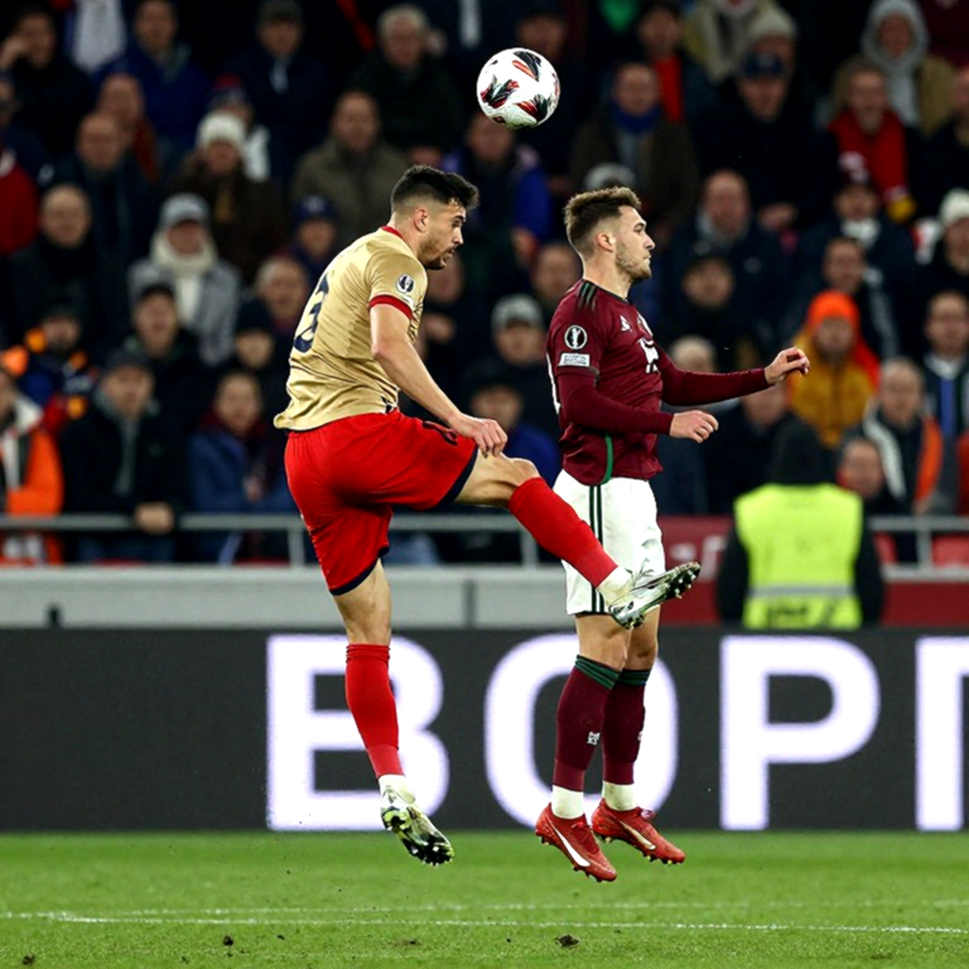
When a big club starts like this, pressure is not distributed evenly. It pools around the manager, the board, and above all the highest earners. That rule has almost no exceptions: when collective results fall, the best-paid player is scrutinised first, not because he plays worst, but because his wage is the most readable signal of expectation.
Five matches is also a very small sample. In sports statistics you generally need ten to fifteen matches before signal separates from noise. At matchday five, every conclusion is a hypothesis. Media pressure, however, does not run on statistics. It runs on the table, and the table is already printed.
A decade of data
Marcus Rashford was born on 31 October 2026 in Manchester. He debuted for the first team on 25 February 2026 against Midtjylland in the Europa League, scoring twice. Three days later he debuted in the Premier League against Arsenal, scoring twice again. An 18-year-old entered elite football with four goals in four days.
He went on to win the FA Cup in 2026, the League Cup in 2026 and the Europa League in 2026. According to the relayed figures, he has 432 appearances for Manchester United, with 138 goals and 79 assists. His peak season was 2026-23, when he scored 30 goals in all competitions.
I studied statistics before journalism, and I trust a ratio more than an impression. Add 138 goals to 79 assists and you get 217 goal contributions in 432 appearances, roughly 0.502 per match. Converted to playing time, assuming 70 minutes per appearance, that is about 0.64 contributions per 90 minutes. That is good. It is not elite.
By comparison, top-tier left wingers across Europe's big five leagues typically sit between 0.7 and 0.85 goal contributions per 90. The gap is roughly half a goal every ten matches. That sounds small. At this level, it is the gap between a starting shirt and a bench role.
A further detail is usually missed. Most of Rashford's goals have come in systems that leave space behind the opposition defence. When his team shifts to possession and opponents sit deep, his output drops sharply. Over many seasons of watching him, the pattern repeats: in open games he remains one of the most dangerous players in the league; against a packed block he becomes average.
That is a technical profile, and it matters far more than verdicts about attitude. It also explains why he is permanently controversial: a player who excels in only one game state will always be read as inconsistent, even when he himself has not changed.
Wages and the reputation filter
According to the source chain, Rashford earns about USD 400,000 a week, more than GBP 310,000 at current rates, the second-highest wage at Old Trafford. A simple calculation shows the weight: held for the two remaining contract years, that is about USD 41.6 million, over GBP 32 million, for one player, before any other cost.
In sports journalism we call this the reputation filter. When a player earns at the top of the scale, all information about him passes through a filter that amplifies emotional range. A routine pass becomes disrespect. A missed shot becomes decline. A muted celebration becomes proof of lost belief.
There is a second effect, less discussed: wage hierarchy in a dressing room. When one player earns several times a teammate's salary without matching output, questions of fairness surface, usually first among those competing for the same position.
That is the psychological layer Owen touched. But he spoke about an individual while the problem is structural. A high earner is not only fighting his own form; he is fighting a label the club attached to him and cannot remove until the contract ends.
The filter has a third direction, which I consider the most important. It changes how the player sees himself. When everyone around you says you are playing badly, and you know you are the best paid in the squad, the gap between external expectation and internal perception widens. Risk behaviour changes: safer choices, fewer duels, less confrontation.
That is exactly the frame I recorded at 1:47 a.m. A player does not skip the dribble because he cannot dribble. He skips it because he has already priced the cost of losing the ball.
Sesko, Cunha and the left flank
This is the most tactical part of what Owen said, and the most easily misread. His argument is a role-displacement mechanism. When Sesko starts as the striker, Cunha has no central slot and drifts left. When Cunha drifts left, the position Rashford once owned becomes second in the queue. Rashford is not dropped purely for poor form. He is dropped because someone else fits the manager's model better.
In Ruben Amorim's system, the left channel is no longer for a runner attacking space behind. It is for a player who can hold the ball in tight areas, combine with an advancing full-back, and create short sequences before the box. Cunha fits the second description. Rashford fits the first.
This separates two kinds of problem. A winger who loses form is a short-term story that can reverse. A winger who loses systemic fit is a long-term story that cannot be reversed by an extra lap in warm-up.
In my own tracking, one small detail is consistent: Rashford receives the ball further from goal than before. In his peak season he regularly took possession between the opposition defence and midfield, where one touch could put him through. Lately his average reception point has dropped towards the halfway line, where every action must start from scratch.
That distance is not caused by form. It is caused by structure. It is why claims about tension or lack of excitement can be right about symptoms and wrong about causes.
There is another point worth noting. Owen's displacement thesis depends on a single variable: Sesko's fitness. If Sesko is fit, Rashford is squeezed out. If Sesko is injured, Rashford has room. An attack designed so that one player's illness restructures everything carries high systemic risk. That says less about Rashford than about how the squad was built.
When nobody will buy
According to the source chain, Manchester United set a fee high enough that no club would buy outright. No concrete figure is given. What is given is a double barrier: high fee and high salary together. In the transfer market these barriers multiply rather than add. A club can absorb a big fee or a big wage, but very few can absorb both for a player with a form question.
There is also a comparison in the source chain: Barcelona reportedly invested USD 77 million in Anthony Gordon rather than pay USD 30 million for Rashford. I report this as cited, and I must state clearly that I could not independently confirm that figure from the transfer-data sources I normally check. If accurate, it implies a valuation gap of about 2.6 times. If inaccurate, it is an example of how an unverified fact can shape an entire narrative.
One financial aspect is little known and makes the situation far more painful. Under UEFA's financial fair play framework and the Premier League's profit and sustainability rules, the book value of an academy graduate is effectively zero, because the club paid no transfer fee to acquire him. Selling an academy player therefore books almost the entire proceeds as pure profit. That is why big clubs love selling their own graduates.
Manchester United did this successfully several times. Scott McTominay joined Napoli in August 2026 for a reported fee of about GBP 25 million. Anthony Elanga moved to Nottingham Forest earlier. Mason Greenwood went to Marseille. Every case generated near-pure accounting profit, funding the transfer budget.
With Rashford, the mechanism should have worked perfectly. An academy graduate, zero book value, any fee is profit. Yet there is no buyer. That is the point I want to press hardest, because it inverts the usual reading.
The problem is not that United do not want to sell. The problem is that the market cannot absorb the wage. The real barrier sits in recurring cost, not the one-off fee line. A club can drop the fee very low, even to zero. It cannot drop the wage without the player's consent. And here there is no sign of that consent.
Two contract years remain. Those two years turn him into a stranded asset: a player the club wants to convert into cash at a price the market rejects, and a player buyers want at a wage they will not accept. Both sides are locked.
Costly precedents
Alexis Sanchez joined Manchester United from Arsenal on a top-of-market Premier League wage. Unable to find a buyer, the club loaned him to Inter Milan while still paying a significant share. That is scenario one: loan with wage subsidy.
Mesut Ozil at Arsenal is another. Out of the sporting plan but on a huge wage, he was held until the contract expired while barely playing. Scenario two: freeze until expiry.
Philippe Coutinho at Barcelona is scenario three: a huge investment, loaned repeatedly, value never recovered. Gareth Bale at Real Madrid is scenario four: a world-class player marginalised by a manager relationship and ending on a subsidised loan.
Rashford currently carries traits of all four. High wage like Sanchez and Ozil. A once-large expected investment like Coutinho. A broken manager relationship like Bale. In all four precedents, the club lost. If history is a guide, the most probable outcomes for United are a subsidised loan or a sale far below the original expectation.
A poisoned relationship
According to the source chain, a public conflict with Amorim in December 2026 permanently altered the player-club relationship. Rashford then sought to leave. He went on loan, played 17 matches with 4 goals and 6 assists, then returned to honour the remaining two contract years.
A public conflict is not merely a media event. It is a structural change in a relationship. Once a manager-player dispute is aired, both sides lose the ability to retreat quietly. The manager cannot reselect him without appearing to concede. The player cannot stay without appearing to accept humiliation.
A player who knows he is unwanted will not run the extra ten metres. That is not an accusation about attitude; it is an observation about the psychology of work. People reduce effort when they believe effort is not recorded. In elite football, those ten metres are the difference between an interception and arriving half a beat late.
A goal at 90+2 does not come from a script, but from those who refuse to leave the pitch when the lights have gone out. For a player to stay until that final minute, he must believe staying means something. That is what United lost in the winter of 2026.
There are two kinds of lost motivation. The first is temporary, after a defeat or a rough patch, recoverable in weeks. The second is structural, when a player believes his situation cannot be changed by effort. Rashford is in the second, because the one thing he could control, finding a new club, already failed.
League context: spending versus output
United sit 12th. They pay the second-highest wage in the league. They still attract elite names such as Sesko and Cunha. Those three facts produce a familiar picture: commercial power outrunning sporting performance.
That equilibrium is fragile. It holds while the brand still generates revenue regardless of results, but only until recurring costs begin to erode investment capacity.
A club does not grow from a budget, but from the nights a whole squad stays awake for a shared belief. United have had the budget to buy almost everything except stability.
The most telling part of this story is the inversion of the academy mechanism. For two decades United built their academy reputation on players such as Ryan Giggs, Paul Scholes, David Beckham and later Rashford. In any big club's internal file, an academy player has two functions: to play, and to generate pure transfer value. When the second function dies, the academy still produces players, but the value chain breaks in the middle.
Contrarian: two misunderstandings
Most coverage reads this as an attitude story. An adored academy graduate now plays casually and is lectured by a club legend on television. That reading is easy, viral, memorable. It misses a harder fact: nobody will buy Rashford, and that matters far more than whether he is playing well. A badly performing player can be fixed. An unsellable player can only be endured. The second option is far more expensive.
The second misunderstanding belongs to the reader. While assembling material for this piece, I found the Vietnamese source chain contained details that do not match established football reality: a claim that Rashford won La Liga during a loan in Spain, a claim that United beat an Azerbaijani club 4-0 on the Champions League league-phase opening matchday, and a USD 77 million fee for a winger I could not verify.
I raise these for professional reasons, not to score points. When an article is built on a chain of facts containing unverifiable items, every conclusion drawn from it should be downgraded. That applies even to conclusions that sound entirely reasonable. I learned this in my own practice: in 2026, when competitions were suspended, I used statistics to survey a grassroots team of 35 members in Lien Chieu district, Da Nang. The results showed 72 percent lost income and 60 percent had no labour contract. Those figures carried weight precisely because they came from a survey conducted directly, not from a chain of relayed sources.
In football, an unverified fact can still generate a wave of opinion. And that wave can genuinely depress a player's market value. That is a loop reporters have a duty to cut.
Signals to watch
Three signals matter over the coming weeks. First, Rashford's minutes once Sesko returns. If he still starts, the displacement thesis needs revisiting. If he is benched, everything Owen said has become description rather than prediction. Second, winter window activity: a loan offer with a wage subsidy would show United have accepted valuation reality; no offer would mean another stranded season. Third, body language, on the pitch and in press conferences; at this stage it is the earliest indicator of the risk Owen named.
A fourth signal is less discussed: Amorim's own position. A managerial change would reshape the relationship entirely.
I will still be sitting on that row on Bach Dang at nearly two in the morning, with a notebook and a pen. The pulse of a match never stops; it only waits for someone who knows how to listen to retell it. What I am waiting for this time is not a goal but a frame: the moment Rashford receives the ball on the left and decides to go past his man, the way he used to. If that frame does not arrive within a few months, the real story has not begun. It is still in its opening chapter, and the opening chapter of a stranded asset is always the easiest to read. The hard part sits in the middle, where a club must choose between admitting it mispriced a player and continuing to pay for a belief that has expired.